What’s in a Representation?
A peer representation is made up of several types of artifacts that Honcho generates through reasoning: Conclusions are insights derived through formal logic. Deductive conclusions are things Honcho can be certain about based on extracted premises. Inductive conclusions identify patterns across multiple messages. Abductive conclusions infer the simplest explanations for observed behavior. For example, if a user frequently mentions work deadlines and rarely mentions hobbies, Honcho might inductively conclude they’re time-constrained or career-focused. Summaries capture the essence of sessions. Short summaries are generated every 20 messages by default, and long summaries every 60 messages. These help compress conversation history into dense, queryable context. Peer cards contain key biographical information. They essentially cache the most basic information about a peer (name, occupation, interests) to ensure the model never loses its grounding. These enable continuous improvement. Each new message refines conclusions, updates summaries, and keeps peer cards current—building a more accurate representation over time.Observation & Perspective-Taking
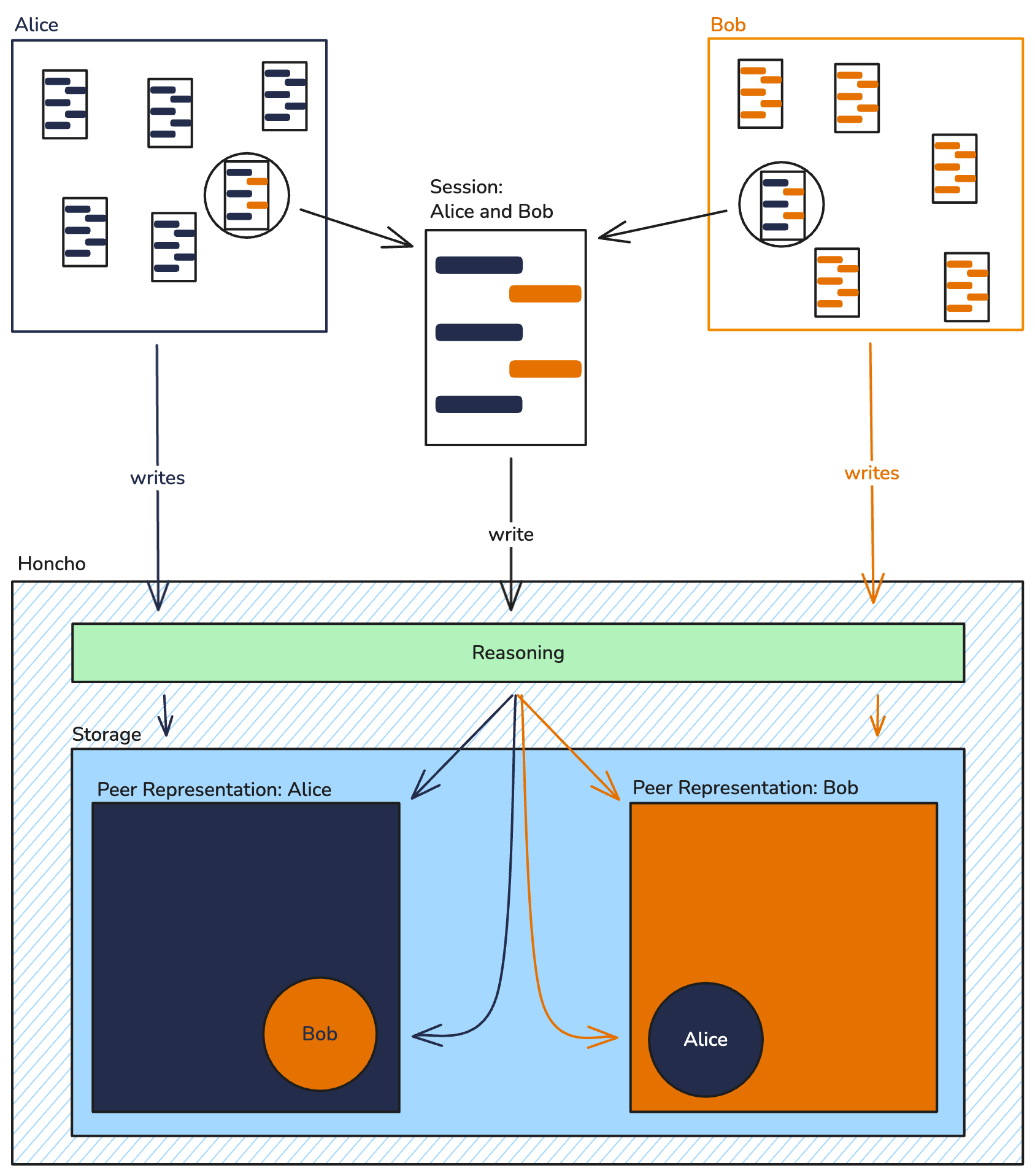
Honcho can build different representations based on what each peer observes. This enables sophisticated multi-peer scenarios where understanding is relative to what was actually witnessed. There are two observation modes controlled by configuration: Honcho observing peers (observe_me): When enabled (default), Honcho forms a representation of the peer based on all messages they’ve sent across all sessions. This is Honcho’s understanding of that peer, built from everything they’ve said and done in your system. Set observe_me: false if you don’t want Honcho to reason about that peer at all.
Peers observing others (observe_others): When enabled at the session level, a peer will form representations of other peers in that session based only on messages they’ve observed. If Alice and Bob are in a session together and Alice has observe_others: true, Alice will form a representation of Bob based solely on what Bob said in sessions Alice participated in. Alice’s representation of Bob will be completely different from Charlie’s representation of Bob if they’ve observed different interactions.
In the diagram below, assume observe_me isn’t turned off (again, default behavior) and observe_others is turned on for both peers in a session that contains the peers Alice and Bob.